Friday, December 16, 2011

Aguja St. Exupery, Aguja de l'S and the "Seven Summits"

On my second trip to Patagonia, in 2005 with my friend Mark Westman, we had many days of good climbing weather. Thus, we had a very busy, fruitful trip, and I was able to complete a goal of mine at the time: to climb the seven main summits of the Fitz Roy ridgeline. This group of peaks includes Aguja Guillaumet, Aguja Mermoz, Fitz Roy, Aguja Poincenot, Aguja Innominata, Aguja St. Exupery and Aguja de l'S. Like any summit "collection" (such as the 14 8,000'ers, the 82 4,000'ers, the Seven Summits, etc), it is a basically silly idea, and depends on one's definition of "main summits." For example, this list does not include the more minor summits of Aguja Val Biois and Aguja Kakito, which are also on the Fitz Roy ridgeline. It also does not include Aguja de la Silla or Aguja Desmochada, which although they are not on the Fitz Roy ridgeline (they are part of a separate, spur ridge), are more difficult summits to reach than Aguja Guillaumet or Aguja de l'S. Nonetheless, these seven summits are generally agreed upon as the main summits of the Fitz Roy ridgeline, are all great peaks, and certainly make a much more interesting collection than the standard "Seven Summits!"

In January 2009, about to fly home from Argentina and return to sitting in a university classroom, I soloed Fitz Roy via the Supercanaleta route. Because of the marginal weather and conditions in which I climbed the route, it remains the most memorable and difficult day that I've ever spent in the mountains. When I arrived the following December in Chalten during the middle of good weather, I immediately hiked into the mountains and soloed Aguja Poincenot via the Whillans route. At this point I began to envision completing the "Seven Summits" by solo ascents, and later that season soloed Aguja Guillaumet and Aguja Mermoz. Although this project has never been my top priority in Patagonia, it has been a fun and challenging journey - perfect to chip away at when lack of big weather windows or good partners did not allow attempting bigger dreams.

After soloing Aguja Innominata last week, I realized that I was getting finally quite close to completing this project, so when another weather window arrived in the forecast a few days later (the Patagonia weather gods must be drunk!), I made plans to attempt Aguja St. Exupery and Aguja de l'S.

I hiked into the Torre Valley on Tuesday, Dec. 13th, and bivied on a small ledge about 300m above the normal Polacos bivouac. Early on the 14th I hiked up the approach gully to the Kearney-Harrington route on Aguja St. Exupery. Although technically easier and shorter than the more popular Chiaro di Luna route, the Kearney-Harringon involves both rock and mixed terrain, so one must climb all the rock with boots, crampons and ice tools in the backpack. With perfect weather, I was comfortable free-soloing the majority of the route, and rope-soloing six pitches. The descent went smoothly, and I arrived back at my bivouac shortly before dark, 16 hours after departing.

The next morning (Dec. 15) I allowed myself to sleep until the leisurely hour of 7:30am, ate some breakfast, and then headed back up the approach gullies, this time to Aguja de l'S. I was tired from climbing St. Exupery, but fortunately Aguja de l'S is a much easier climb. I climbed Aguja de l'S via the north ridge, which is a variation of the Austrian route. I belayed a short approach step, and then free-soloed all of the route except for one pitch. The descent went smoothly again, and that evening I hiked back to town.

Except for the Supercanaleta, none of the rest of these seven solos are among my best climbs. Mermoz, Innominata and St. Exupery are all technically more difficult than the Supercanaleta, but much shorter, less committing climbs. I am proud of the achievement as a whole though, and it has been a good journey. At the very least, I have learned a lot about soloing highly-technical alpine terrain, and perhaps some day I can apply those skills to bigger dreams.

Jugging back up the second pitch that I belayed on the Kearney-Harrington:


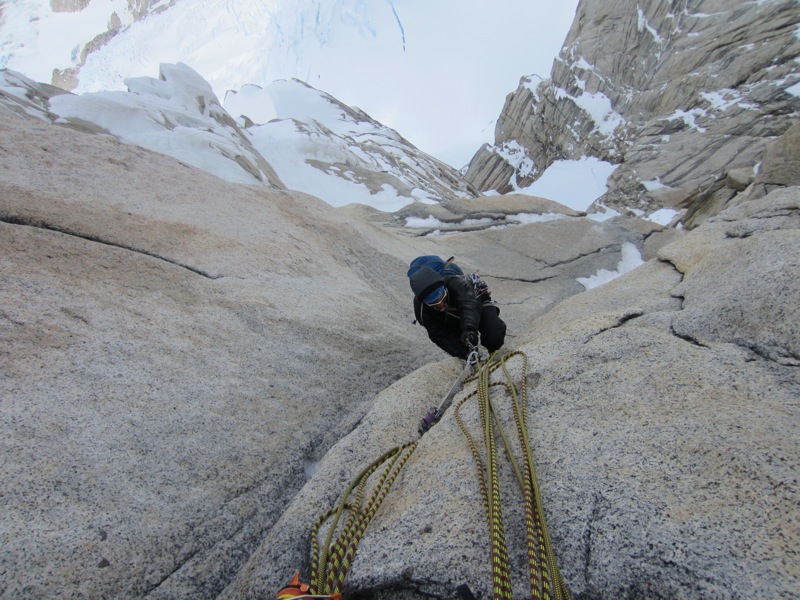
Climbing in the main ramp system that is the defining feature of the Kearney-Harrington route:


Taking a break on a ledge part-way up the Kearney-Harrington:


A lot of the Kearney-Harrington route is somewhat chossy, but it has some nice sections as well. In particular, the last pitch to gain the upper east buttress is excellent:


The upper part of the Kearney-Harrington route, on St. Exupery's upper east buttress, is mostly a mix of snow ramps and short but steep rock steps:


I'm glad this didn't happen until the last hard pitch:


Jugging back up the last steep pitch on St. Exupery's upper east buttress:


The summit of Aguja St. Exupery:


Self-portrait on the summit of St. Exupery:


The upper north aspect of Aguja de l'S after climbing the approach pitch. I climbed the obvious, deep chimney:


Taking a break in the chimney on Aguja de l'S:


Handcracks on all sides!


This is the pitch on Aguja de l'S that I decided to belay:


Some low-angle squeeze-chimney near the top of Aguja de l'S:


The summit of Aguja de l'S:


Self portrait on top:


On the hike back down to Niponino from Aguja de l'S, I ran into Jason Kruk and Hayden Kennedy, who had just climbed Aguja St. Exupery via Chiaro di Luna. Thursday was one of the hottest days I have ever experienced in Patagonia, and generally mountains begin to fall apart when it gets hot. We witnessed a massive rockfall coming off of El Mocho:

Saturday, December 10, 2011

Aguja Innominata (aka Aguja Rafael) Solo

After my Standhardt adventure with Jorge, I got in two days of rest in town before another mini-window appeared in the forecast, and I hiked back into the Torre Valley. I spent the night of Dec. 7 at the Polacos bivouac, and departed at 5:00 am the next morning for a solo attempt on the Anglo-American route on Aguja Innominata (aka Aguja Rafael).

This past summer in Squamish I dedicated some time to teaching myself how to rope-solo, and I went to Innominata in part to test these skills. However, all my rope-soloing in Squamish was on routes with bolted belays and 100% sound, clean rock. Due to the often flakey and loose rock on Innominata, I sometimes put 5 pieces of gear in to make belays that I felt were completely trustworthy of upwards and downwards loading.

I think that I rope-soloed approximately 50% of the terrain on the route, and free-soloed 50% of the terrain. However, I would estimate that I spent 90% of the time on the ascent rope-soloing, and only 10% of the time free-soloing. All in all, soloing Innominata took a lot more time and effort than I had expected!

Correction (Dec. 16):
In 2005 Jon Walsh fixed two ropes on a new route on Innominata (called "Comono"), and returned a few days later to complete the route to the summit by himself, making the first solo ascent of Aguja Innominata in the process. In 2007 Chilean climber Jimmy Mora soloed the Anglo-American route, making the second solo ascent of Innominata.

Morning light on the Torres from the Innominata-Poincenot approach gully:


Looking up at Aguja Innominata from the Innominata-Poincenot approach gully:


Rope-soloing a pitch on the lower ramp:


Jugging back up the last pitch to gain the west ridge:


Jugging back up one of the last pitches:


The view of Aguja St. Exupery from the summit of Innominata:


On the summit of Innominata, a lot later and more tired than I had expected!


The next morning, rain showers and morning sunlight mixed in the Torre Valley for some awesome lighting. The view of Cerro Solo from the Polacos bivouac:


And yet again, a Torre valley rainbow!

Tuesday, December 6, 2011

Cerro Standhardt, El Caracol

On November 30th, I hiked into the Torre Valley with my friend Jorge Ackerman, who is from Bariloche, but has been living in Squamish for the past year. We hoped to climb Torre Egger via the O'Neil-Martin route, so continued past Niponino to the Norwegos bivouac. On December 1st we left Norwegos early, and hiked up the glacier to start climbing at 5:30am. I made a route-finding mistake on the first few pitches, which cost us some time. Additionally, conditions were poor, and pitches that are normally easy in rock shoes required climbing with crampons and ice tools. After climbing six pitches, due to the poor conditions and our lack-of-bad-ass-ness, we decided that we were moving too slowly for our planned itinerary and supplies, and bailed. We descended to Niponino that night, but the decent weather was forecasted to hold for a couple more days, so we rested in Niponino on the 2nd, and hiked back up to Norwegos that evening.

We left Norwegos again early on the morning of December 3rd, planning to climb Festerville (the north ridge) on Cerro Standhardt. On the way up to the Standhardt Col, strong winds caused us to reconsider our plans for Festerville, which is very exposed to the wind. We quickly changed objectives to the un-finished south face of Standhardt, which had been almost climbed in 1977 by a British party, and had since repulsed a few other attempts over the years.

Jorge led the first couple tricky mixed pitches above the Standhardt Col, and then we simul-climbed across the long ramp that cuts diagonally up Standhardt's east face. After turning the corner onto the south face, Jorge led a mixed pitch up and left that brought us to the main dihedral system which is the defining feature of the south face. I led the next four pitches, the first two of which were predominantly aid climbing, and the second two which were mostly free climbing on mixed terrain. On the first of these four pitches, Jorge thought that we should choose the left of two cracks, but I foolishly chose the right crack. When it disappeared into blank rock, I had to make two large pendulums to gain the crack system to the left, and we lost a bunch of time from this route-finding blunder of mine.

Jorge led the next ice pitch, which brought us almost to the top of Standhardt's south face. From here I thought we ought to traverse to the left, but Jorge opted to go straight up instead. Once again his route-finding proved to be right on, and the chimney directly above provided the key to exiting the face. This exit chimney was very steep (overhanging), and probably the crux of the route. Fortunately, a knifeblade crack on the right wall of the chimney made for somewhat straightforward, but strenuous aid nailing.

From Jorge's belay above the exit chimney, I made a few aid moves on rock (and a short fall when a micro-cam popped out of a dubious placement), and then some rime climbing to top out the south face. As usual, the Standhardt summit mushroom was easy and straightforward AI3, and we reached the summit at 9:00pm.

The weather had been steadily deteriorating throughout the day, and by the time we topped out we were both climbing in our belay parkas. Of course it was a pleasure to finish the route, but reaching the summit was also a great relief, because we could descend the relatively-straighforward rappels of Exocet, rather than an epic descent of the Toboggan route, which climbs to the col between Standhardt and Punta Herron. We made all but the first few rappels in the dark, and eventually reached Norwegos just after first light, 25 hours after departing.

We have named the route El Caracol, which means "the snail." This is in part because the word "caracol" in Spanish refers to a spiral shape (that of a snail's shell), which is fitting for our route, but also because of our snail-like pace on the tricky pitches.

Leading an iced-up dihedral on the lower portion of the O'Neil-Martin route on Torre Egger:


Jorge at our high-point on Torre Egger:


Almost done with our bail from Torre Egger:


Jorge leading the first pitch above the Standhardt Col:


Jorge climbing the ramp on Standhardt's east face:


Jorge's belay on the corner of the east and south faces of Standhardt:


Jorge starting up the first pitch on the south face, mixed climbing up and left, with the summits of Cerro Torre and Torre Egger in the background:


Jorge following a quick and easy ice traverse, with the summits of Poincenot, Inominata, St. Exupery, and de la S on the other side of the valley:


Looking down the slow aid pitch, on which I chose the wrong crack, and had to make two time-consuming pendulums to the left:


Feeling a bit worked after the slow aid lead:


Jorge coming up to the belay above the slow aid lead. At the end of this pitch I aided off of two ice screws, because I had left my pack (and therefore my boots and crampons) hanging below.


Jorge following the second aid lead:


Jorge following the last pitch of my block, up classic mixed goullotte climbing:


Jorge starting up an ice pitch near the top of the south face:


Jorge leading the crux exit chimney:


Jorge arriving at the base of the summit mushroom:


Jorge on the summit of Cerro Standhardt:


When we returned to Norewgos we were cold, wet and tired... but at least there was a rainbow!


The south face of Standhardt, showing the line of El Caracol (500m, 5.9, A1+, M4). The route we took is marked (with the pendulum), as well as the route that future parties ought to take, on the crack further to the left.

Saturday, November 12, 2011

Cerro Pollone Attempt

I have returned to El Chalten, in Argentine Patagonia, for hopefully
some more great climbing in the Fitz Roy and Cerro Torre massifs. As
seems to be my un-breakable curse, I arrived just a bit too late to
take full advantage of a weather window. Fortunately, at least this
year the weather window that I missed was not as spectacular as the
ones I missed the past few years.

I hiked into the Torre Valley on the best weather day, Monday, Nov. 7,
and on Tuesday made an attempt on Cerro Pollone, via its original
South Face route. The route was first climbed by an Argentine team in
February 1949, and in the 62 years since it has not been repeated (at
least as far as Patagonia climbing historian Rolando Garibotti is
aware). Cerro Pollone itself did not even see a second ascent until
last February, when Blake Herrington and Scott Bennett reached the
summit via the West Pillar.

The South Face route on Cerro Pollone is not difficult however (at
least until the last 30 meters), and I figured that even alone it
would make a nice mellow warm-up for the Patagonia climbing season. I
left the Niponino bivouac at 4:30 am on Tuesday, and with pretty good
snow conditions, made good time up the icefall at the head of the
Torre Valley to the base of Cerro Pollone's South Face.

The south aspect of Cerro Pollone, from down in the Torre Valley, with
the Filo del Hombre Sentado in the right foreground, showing the line
I attempted. On the lower part I climbed to the right of the rock
buttress, while the original route went to the left, simply because it
looked easy and made the approach shorter.


Looking up Cerro Pollone from below the bergschrund. The mellow ice
flow on the right was a totally contrived variation, but was fun to
climb anyways, mostly just because I hadn't done any ice climbing in
several months:


Nice, plastic water ice:


Most of Cerro Pollone's South Face is a mix of low-angle ice climbing
and navigation around crevasses and bergschrunds. The last 30m summit
tower, however, is the crux of the climb:


After climbing 30 meters of moderate mixed terrain, I was turned
around 2 meters below Cerro Pollone's summit! The final summit block
seemed to be blank rock, covered with too much rime to see any crimps,
and too little rime to climb the rime itself. In any event, trying to
surmount it seemed too sketchy to properly try with a minimalistic
self-belay system. I've been turned around near the tops of mountains
before, but I have never before reached my ice tool to 40cm below the
summit without being able to actually get on top of it!


Despite not being able to complete the ascent, it was nonetheless a
nice warm-up, and climbing on Cerro Pollone provided some cool views
and difference perspectives than I have normally seen in the Torre
Valley. The view to the south, with the Torres on the left in a
cloudcap, and Cerre Piergiorgio, with its fantastic west wall in
profile, on the right:


The view to the east, with an awesome perspective on the Fitz Roy
massif, Cerro Pollone's lower east summit in center, and Aguja Tito
Carrasco in the lower left.

Friday, September 9, 2011

Slesse Climbs

During the past few weeks I have spent most of my time in Squamish, trying to progress my rock free-climbing skills. I have also been teaching myself how to rope solo, and after practicing on some smaller routes I soloed the Grand Wall and University Wall. I have made a couple forays into the mountains, however - twice to Mt. Slesse with Sarah Hart.

In August we climbed the Northeast Buttress. The Nesakwatch Creek Road was in bad shape, and we had to walk the last few kilometers to the trailhead. The slabs from the propellor cairn to the 4th-class notch in the lower East Buttress were covered in ice blocks, and we almost decided to turn back because of them. The Pocket Glacier itself was in very bad shape, and we had to climb 4-5 pitches of difficult climbing to gain the 3rd-class ramp that is normally used to access the Northeast Buttress. The Northeast Buttress itself went excellently, and the Crossover Pass descent trail that we made last summer is in good shape.

Yesterday we went back to Slesse, with plans to climb the East Buttress (1993 Beckham-Child route). The East Buttress looked quite wet, so we instead climbed the South Peak by a combination of the Southeast Buttress and the gully between the South Peak and the Third Peak. We visited the site of the plane crash, which was an intense experience. We again descended via the Crossover descent.

Fortunately, sometime around the last few days of August, the road up Nesakwatch creek was re-graded, and you can currently drive all the way to the trailhead (the new trailhead, circa 2005, not the old one) in a Subaru.

We plan to go back to Slesse on Saturday, Sept. 17 to work on the trail. The trail has become very overgrown with bushes the past few years, and it is a shame that the access to such an awesome peak isn’t better maintained. If you are interested in helping with the trailwork, send me an e-mail (colinhaley1 AT gmail) with “Slesse Trail Work” in the subject line. Anyone involved will bring their own tools - mostly clippers/loppers will be useful. Even if you’ve never climbed Slesse before, it could be a nice way to learn the access and approach. If the weather is still good, anyone can sleep out on Saturday to climb Slesse on Sunday.


Sarah passing the snow-covered propeller cairn in August. There was much more snow on the ground than typical for the date:


The condition of the pocket glacier in August:


Sarah climbing excellent but time-consuming rock to access the Northeast Buttress:


Some runout but fortunately easy face climbing, just before joining the standard Northeast Buttress start:


Sarah on the Northeast Buttress above the 5.10 direct variation:


High on the Northeast Buttress in the mist:


Sarah on the summit of Mt. Slesse:


After returning to Slesse, Sarah starting up our climb of the South Peak:


Halfway up the southeast side of the South Peak:


Sarah nearing the summit of the South Peak of Slesse:


Sarah making the second of two rappels off the South Peak, into the notch between the South Peak and the main summit:


An evening view back towards Slesse from the Crossover descent route: